Ask anything
Start a new conversation below.
Claude Opus 4.8 API for Coding Agents and Knowledge Work
Build AI applications with stronger coding ability, sharper task judgment, and more reliable collaboration using Claude Opus 4.8 API on EMix.ai.
What's New in Claude Opus 4.8 API
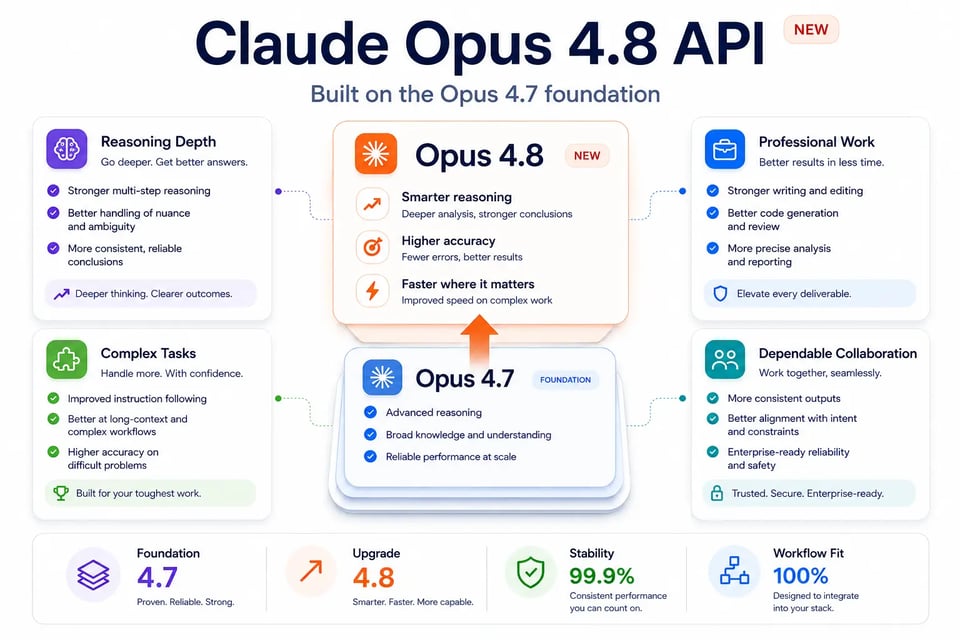
Claude Opus 4.8 API Upgrades the Opus 4.7 Foundation
Built as the next version of Claude Opus, Claude Opus 4.8 API improves on the Opus 4.7 foundation while keeping the model focused on high-value professional work. Developers can use it for applications that need stronger reasoning depth, more dependable collaboration, and better handling of complex tasks across technical and knowledge-heavy workflows.
Stronger Coding Agentic Reasoning and Knowledge Work with Claude Opus 4.8 API
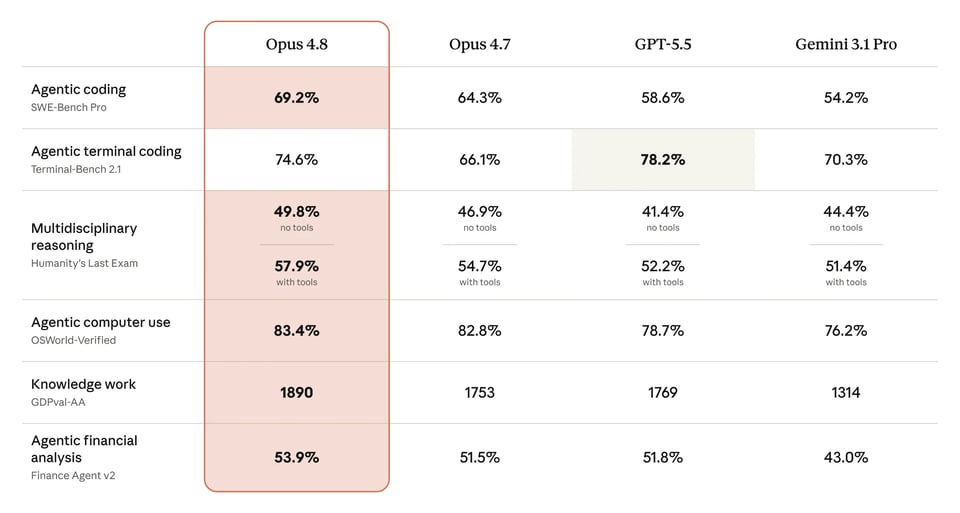
Across benchmark categories, Claude Opus 4.8 API improves in areas such as coding, agentic skills, reasoning, and practical knowledge work. This makes it a strong fit for software engineering assistants, research tools, workflow agents, document analysis systems, and products that need more than basic text generation.
Claude Opus 4.8 API Provides More Reliable Agentic Collaboration
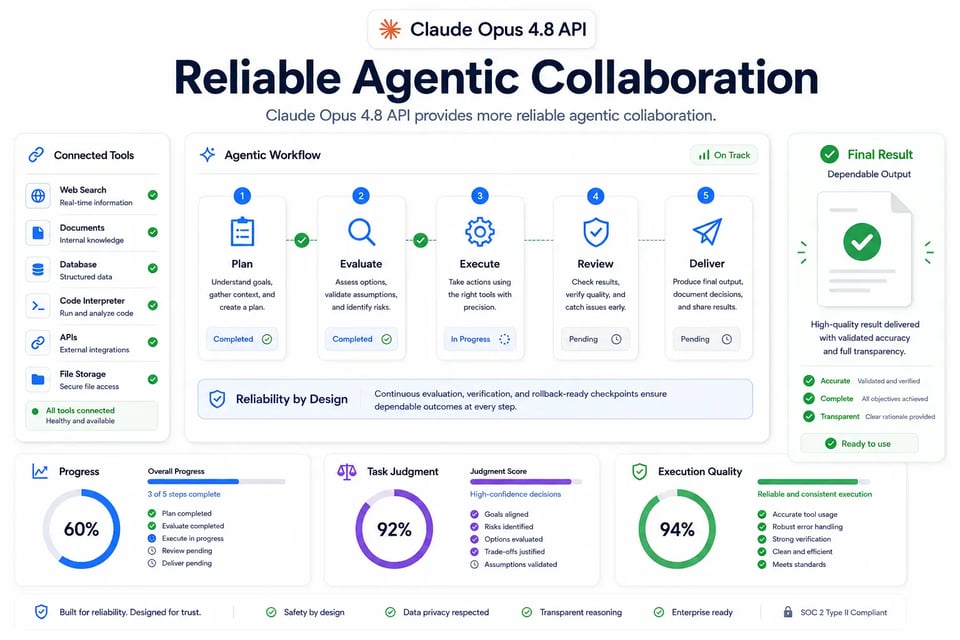
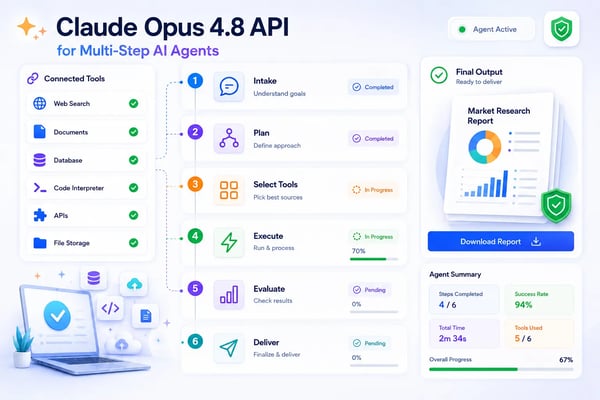
Early testing highlights Claude Opus 4.8 as a more effective collaborator when performing agentic tasks. For workflows that require planning, progress evaluation, multi-step execution, and careful task judgment, Claude Opus 4.8 API can help applications deliver a more dependable user experience.
Better Honesty and Code Issue Awareness in Claude Opus 4.8 API
A key improvement in Claude Opus 4.8 API is its stronger honesty during complex work. Instead of confidently claiming progress when evidence is weak, Claude Opus 4.8 is more likely to flag uncertainty and call attention to possible issues. In coding workflows, it is also less likely to leave flaws in its own generated code unmentioned, which helps users review and verify results more effectively.
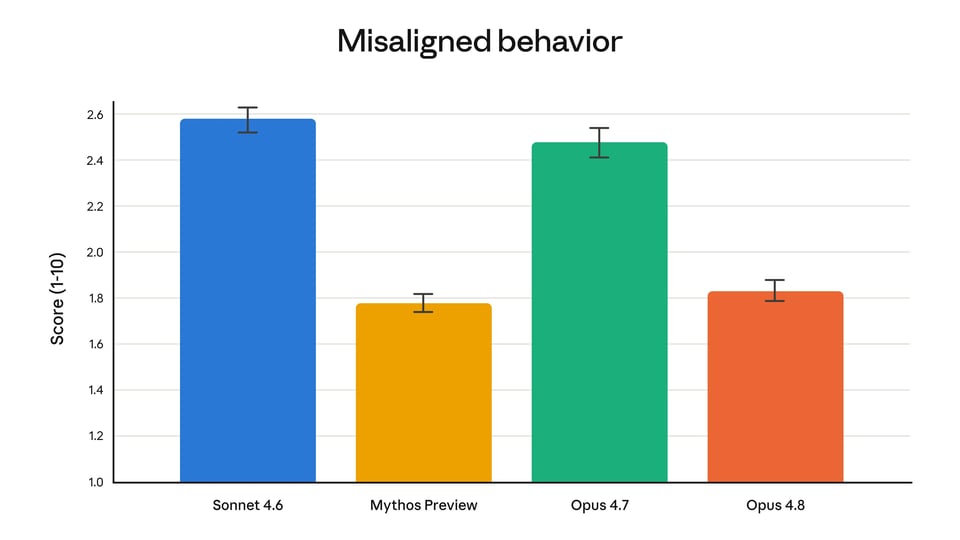
How Claude Opus 4.8 Compares with Other Advanced AI Models
Claude Opus 4.8 is positioned for complex coding, agentic reasoning, long-context work, and professional knowledge tasks where reliability matters more than simple speed. Compared with Opus 4.7, it brings more refined behavior and stronger honesty; compared with Sonnet 5, it is better suited for harder agentic workflows; compared with GPT 5.5, it has advantages in constrained multi-file engineering tasks; and compared with Mythos, it remains the more practical broadly available Opus-level choice for production use.
| Comparison Area | Claude Opus 4.8 | Claude Opus 4.7 | Claude Sonnet 5 | GPT 5.5 | Claude Mythos |
|---|---|---|---|---|---|
| Model Positioning | Advanced Opus model for complex coding, agentic work, reasoning, and knowledge workflows | Previous Opus version with strong reasoning but less refined behavior | Balanced Claude model for faster, structured, and high-volume workflows | Frontier GPT model with strong coding fluency and general-purpose reasoning | Higher Claude tier for the most difficult reasoning and research tasks |
| Best Fit | Complex agents, large codebase work, long-form analysis, and high-value professional tasks | Workflows already calibrated around Opus 4.7 behavior | Structured tasks, real-time assistants, simpler agent steps, and scalable everyday use | Greenfield coding, test generation, cross-language translation, and developer productivity | Frontier research, hardest reasoning tasks, and specialized advanced workflows |
| Agentic Workflow Strength | Strong for planning, multi-step execution, tool-chain reasoning, and complex task recovery | Capable, but more likely to hedge, drift, or add unnecessary commentary | Reliable for predictable workflows, but weaker on open-ended planning and recovery | Strong general agent support, but task fit depends heavily on prompt and workflow design | Designed for deeper agentic capability, though access may be more limited |
| Coding Performance | Strong for multi-file reasoning, refactoring, bug localization, and constrained implementation | Good coding ability, but less consistent with strict instructions and style constraints | Useful for common coding tasks and structured implementation steps | Strong for first-pass code generation, cross-language translation, and conventional test writing | Expected to target harder coding and reasoning tasks beyond standard Opus-level use |
| Instruction Following | Better at staying aligned with detailed, multi-part instructions across longer tasks | More prone to over-explaining, softening, or adding caveats | Works well when workflows are clearly defined and predictable | Handles conversational prompts well, but may be less precise with strict constraints | Built for advanced reasoning, though practical behavior depends on deployment context |
| Reliability and Judgment | Stronger honesty, better uncertainty awareness, and improved handling of possible code flaws | More likely to hedge or agree with flawed premises without enough pushback | Reliable for routine tasks, but less robust when ambiguity and error recovery increase | Strong output fluency, though constrained tasks may need more review | Highest-capability direction, but not the default practical choice for most builders |
| Long-Context Work | Strong for maintaining task state, tracking dependencies, and preserving context over complex workflows | Good long-context ability, but less stable in demanding sessions | Handles long contexts, but works best with clearer and more bounded workflows | Capable with long inputs, though context-use behavior depends on task type | Positioned for extended reasoning and very hard context-heavy tasks |
| Practical Choice | Best when quality, reasoning depth, and reliability matter more than speed alone | Useful mainly for comparison or legacy workflows | Good for simpler, faster, or more structured steps in a multi-model workflow | Strong alternative for coding fluency, testing, and broad developer productivity | Worth watching for frontier tasks, while Opus 4.8 is more practical for current production use |
How Can Developers Start Building with Claude Opus 4.8 API on EMix.ai
Get started with our product in just a few simple steps...
Step 1: Create an EMix.ai Account and Open the API Dashboard
Step 2: Generate Your Claude Opus 4.8 API Key
Step 3: Build Your First Claude Opus 4.8 API Workflow
Step 4: Evaluate Outputs and Optimize for Production
What Can Developers Build with Claude Opus 4.8 API
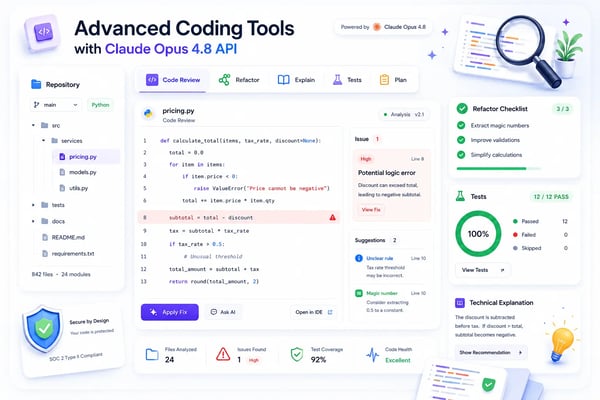
Advanced Coding Tools with Claude Opus 4.8 API
Software teams can use Claude Opus 4.8 API to support code review, debugging, refactoring, implementation planning, and technical explanation. Its stronger coding and reasoning performance makes it useful when an application needs to follow detailed constraints, understand project context, and help developers move from issue analysis to practical code changes.
Claude Opus 4.8 API for Multi-Step AI Agents
Agentic products can use Claude Opus 4.8 API for planning, task execution, progress evaluation, and result review across complex workflows. This fits internal copilots, automation agents, technical assistants, and workflow systems that need to handle multi-stage instructions instead of returning a single short response.
Research and Document Review with Claude Opus 4.8 API
Research platforms can apply Claude Opus 4.8 API to summarize long materials, compare information, extract structured insights, and produce clear analysis from reports, policies, technical documents, or internal knowledge bases. Its improved honesty around uncertainty helps users identify where information may need further review.

Claude Opus 4.8 API for Professional Knowledge Work
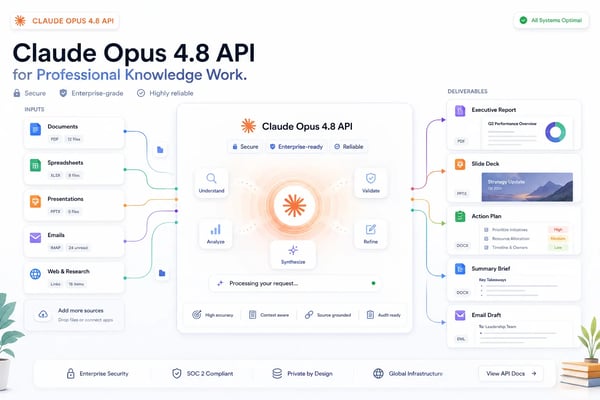
Business and productivity tools can use Claude Opus 4.8 API for drafting reports, preparing briefs, organizing meeting notes, building presentation outlines, reviewing internal content, and creating structured deliverables. This is useful for teams that need AI support for high-value work where clarity, consistency, and careful judgment matter.
Why Developers Choose EMix.ai for Claude Opus 4.8 API Integration
Cost-Efficient Claude Opus 4.8 API Pricing for Flexible Testing
Developers can use EMix.ai to test Claude Opus 4.8 API across real workflow scenarios before moving into larger production usage. This is useful for teams that need to evaluate prompt quality, response consistency, reasoning behavior, and task performance across coding agents, research tools, internal copilots, or document analysis systems.
Complete Claude Opus 4.8 API Documentation for Easier Integration
Clear documentation is important when teams move from testing to production. EMix.ai provides API documentation to help developers understand request structure, authentication, supported parameters, model access, and implementation details. Before deployment, always check the latest API docs for the current Claude Opus 4.8 API configuration.
24/7 Claude Opus 4.8 API Support for Developer Workflows
Technical issues can slow down AI product development, especially when teams are building agentic workflows, coding assistants, or document-heavy applications. EMix.ai offers 24/7 support to help developers handle integration questions, API usage issues, and workflow setup needs while building with Claude Opus 4.8 API.
Multiple AI Models Alongside Claude Opus 4.8 API on EMix.ai
Many production systems need different models for different task types. EMix.ai gives developers access to multiple AI models, making it easier to compare Claude Opus 4.8 API with other options and choose the right model for each workflow, from advanced reasoning tasks to faster or lighter model use cases.