Ask anything
Start a new conversation below.
OpenAI GPT-5.5 API for Complex Work and Deeper Reasoning
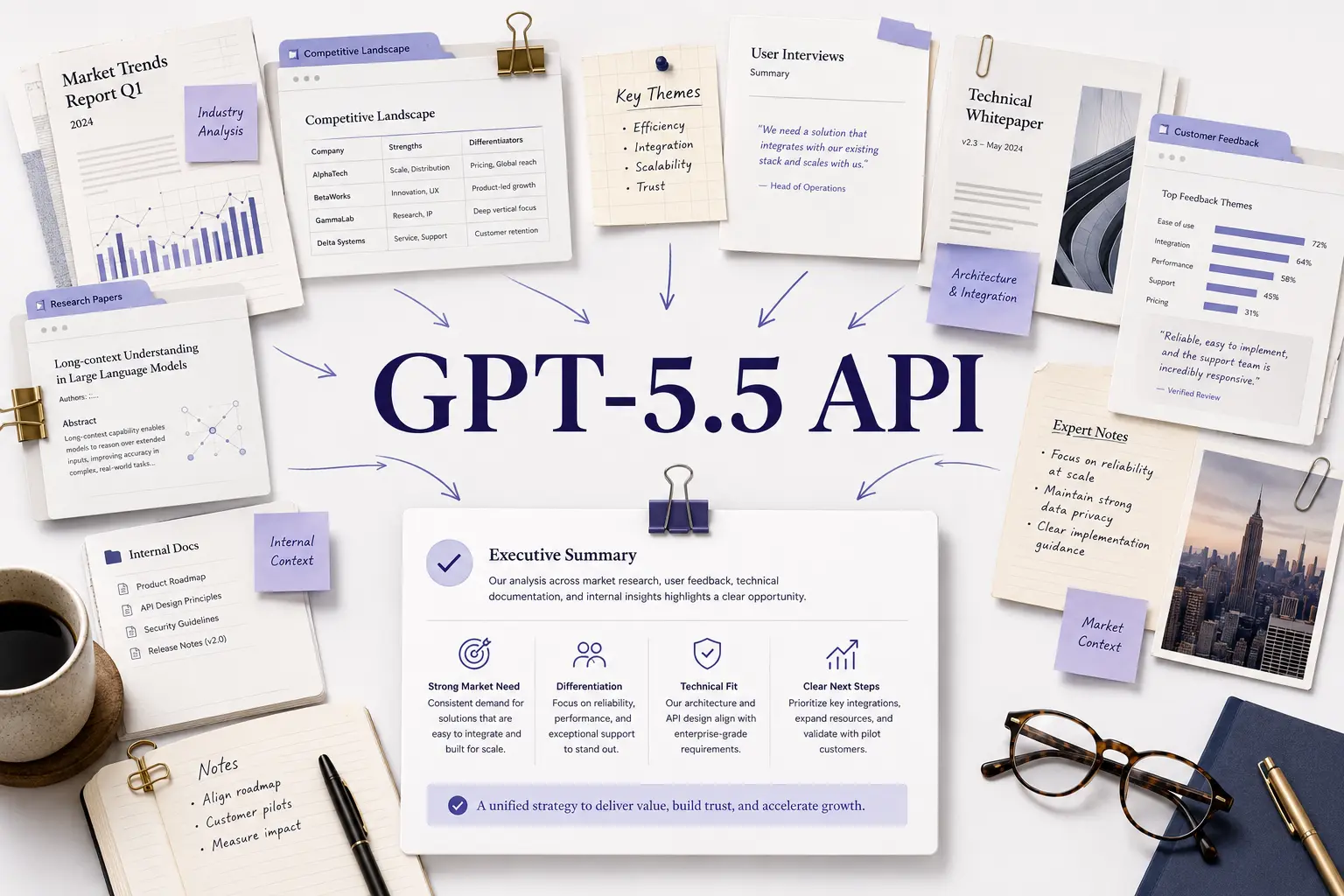
Access GPT-5.5 API to bring stronger reasoning, deeper coding intelligence, long-context understanding, and more reliable task execution into advanced AI systems.
Core Intelligence Upgrades in GPT-5.5 API
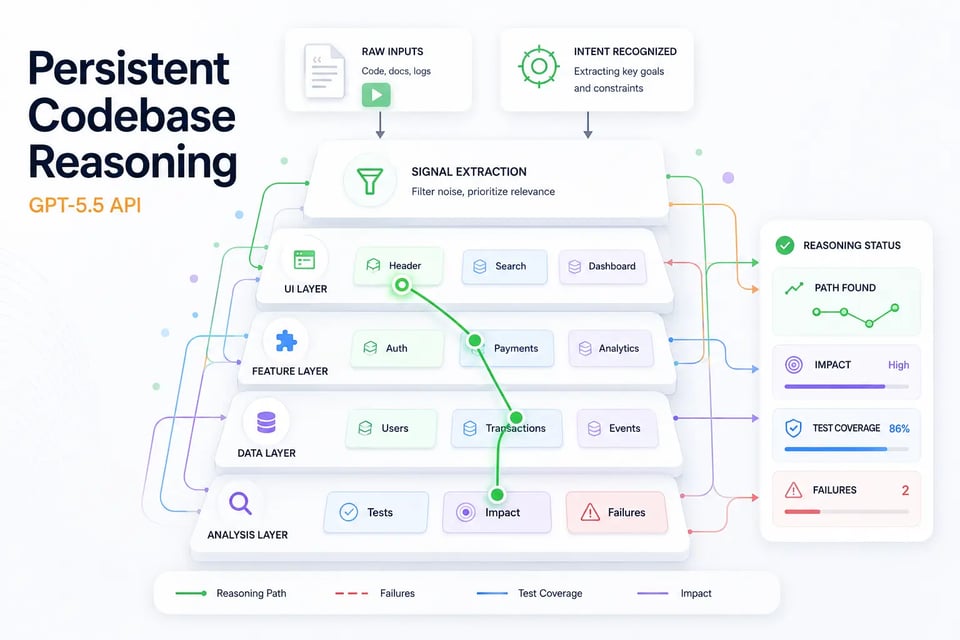
Persistent Codebase Reasoning for Longer Engineering Tasks in GPT-5.5 API
GPT-5.5 API improves coding intelligence by maintaining a clearer view of software structure across longer technical tasks. GPT-5.5 can reason through implementation intent, dependency relationships, failure causes, test expectations, and surrounding code impact with stronger continuity than GPT-5.4. This matters because complex coding work rarely depends on one isolated answer. It often requires understanding why a system behaves incorrectly, deciding where a change belongs, checking assumptions, and keeping implementation details aligned across multiple steps. GPT-5.5 API strengthens that full reasoning path rather than only improving code generation quality.
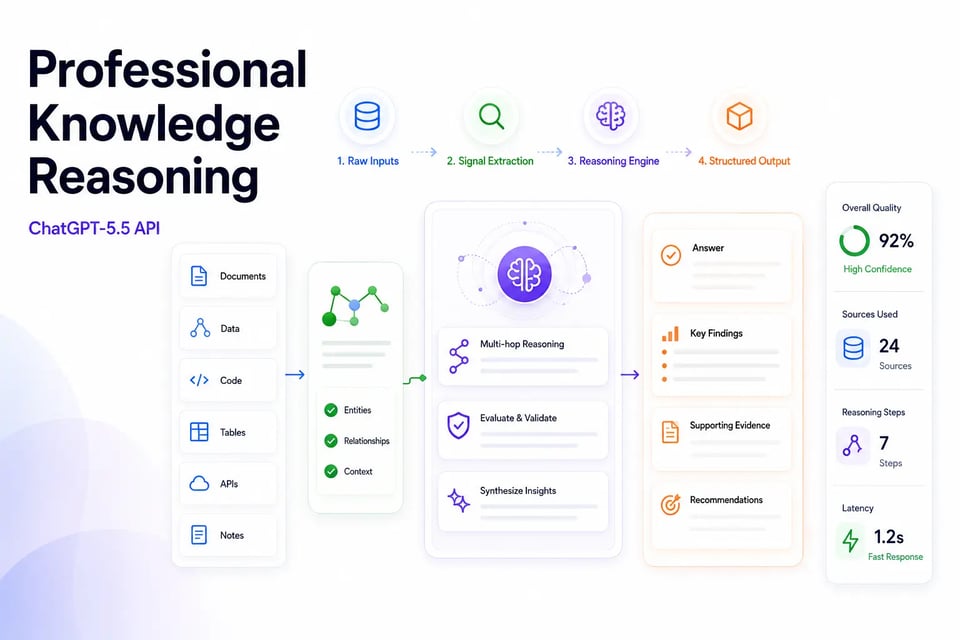
Professional Knowledge Reasoning with Clearer Structure in ChatGPT-5.5 API
ChatGPT-5.5 API improves how GPT-5.5 handles professional information flows that involve unclear inputs, dense context, tool results, and structured output requirements. GPT-5.5 is stronger at recognizing user intent, separating relevant information from background noise, checking whether an answer satisfies the task, and turning raw material into a clearer final result. Compared with earlier GPT-5 generations, the upgrade is less about adding more text and more about producing better-organized reasoning: cleaner synthesis, tighter prioritization, more useful structure, and stronger alignment between the input context and the final response.
Research-Grade Analytical Continuity for Complex Technical Reasoning in GPT-5.5 Pro API
GPT-5.5 Pro API strengthens scientific and technical reasoning by improving continuity across multi-stage analytical problems. GPT-5.5 shows stronger behavior when a task requires evidence review, uncertainty handling, statistical interpretation, technical comparison, or step-by-step refinement of a research direction. Compared with GPT-5.4, gains on research-oriented evaluations such as GeneBench and BixBench point to better handling of ambiguous data, quality-control issues, and complex interpretation. The core improvement is not simple factual recall. GPT-5.5 Pro API is better at keeping a research thread coherent as the reasoning path becomes longer and more technical.

Higher Intelligence with More Practical Inference Behavior in OpenAI GPT-5.5 API
OpenAI GPT-5.5 API improves the balance between stronger reasoning and practical inference behavior. GPT-5.5 reaches a higher capability level while maintaining GPT-5.4-level per-token serving latency, and it can complete some Codex-style tasks with fewer tokens. This is an important capability upgrade because advanced reasoning becomes less useful when every complex task creates heavy latency, excessive continuation, or repeated retries. GPT-5.5 API focuses on using reasoning effort more effectively, keeping execution more targeted, and making high-intelligence workflows easier to operate at scale.
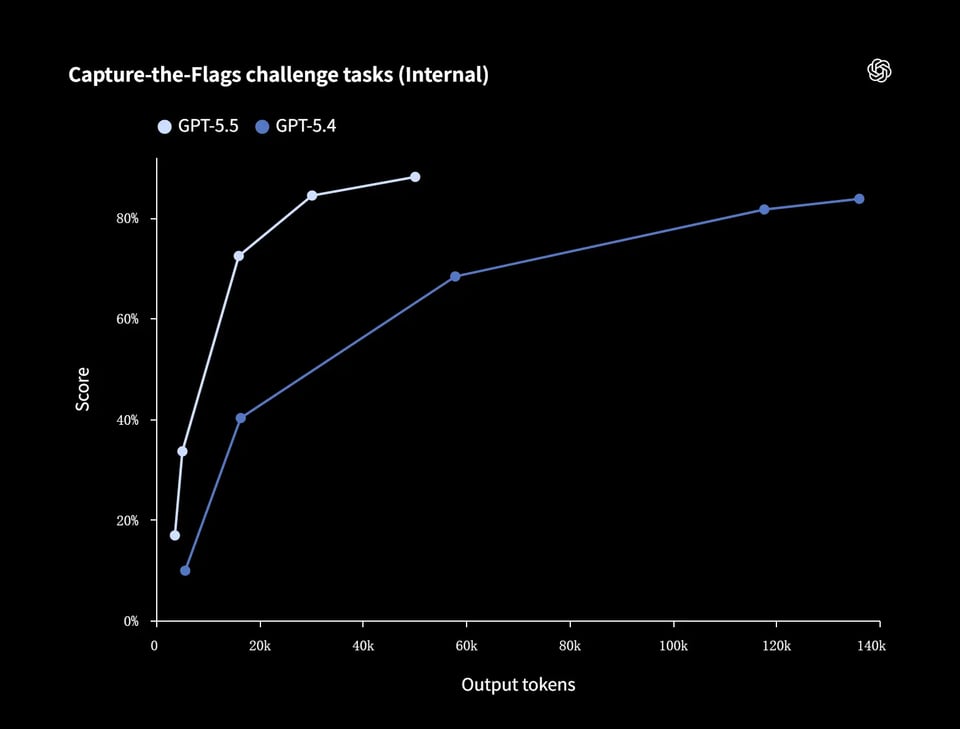
Cybersecurity-Aware Reasoning with Stronger Safety Boundaries in GPT-5.5 API
GPT-5.5 API advances cybersecurity-related reasoning while placing stronger boundaries around sensitive or higher-risk behavior. GPT-5.5 improves technical understanding for security concepts, risk analysis, vulnerability context, and defensive reasoning, while stricter safeguards help prevent unsafe escalation. Compared with GPT-5.4, GPT-5.5 shows stronger cybersecurity evaluation performance, but the more important positioning is controlled capability: deeper security reasoning, better risk recognition, and safer handling of requests that require careful judgment. This keeps cybersecurity intelligence aligned with defensive, safety-aware use rather than unrestricted technical automation.
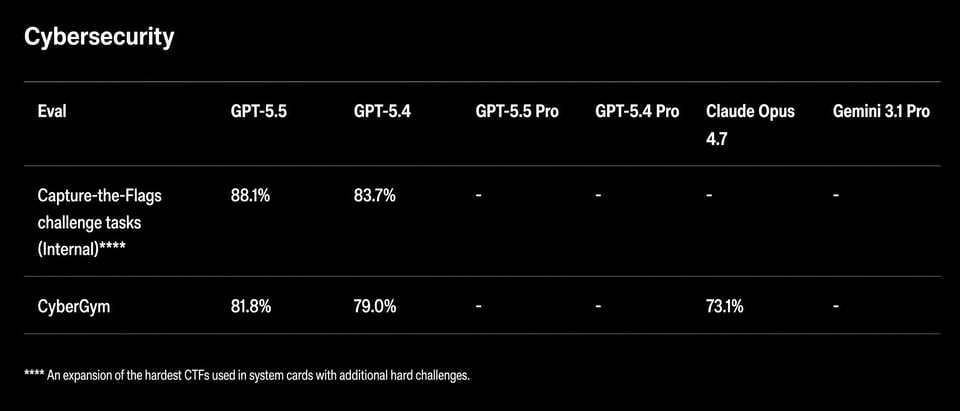
GPT-5.5 Benchmark Comparison with Claude Opus 4.7 and Gemini 3.1 Pro
GPT-5.5 delivers a broader capability upgrade over GPT-5.4 across coding execution, professional reasoning, computer-use tasks, tool-based workflows, academic evaluation, cybersecurity, long-context retrieval, and abstract reasoning. This benchmark table compares GPT-5.5 and GPT-5.5 Pro with previous GPT-5 models, while also using Claude Opus 4.7 and Gemini 3.1 Pro as frontier-model references for competitive context. Because benchmark coverage differs by model and some evaluations use specific research settings, these results should be read as capability signals rather than fixed production guarantees. The benchmark data is based on OpenAI official evaluation results.
| Evaluation Area | Benchmark | GPT-5.5 | GPT-5.4 | GPT-5.5 Pro | GPT-5.4 Pro | Claude Opus 4.7 | Gemini 3.1 Pro |
|---|---|---|---|---|---|---|---|
| Coding | SWE-Bench Pro | 58.60% | 57.70% | — | — | 64.30% | 54.20% |
| Coding | Terminal-Bench 2.0 | 82.70% | 75.10% | — | — | 69.40% | 68.50% |
| Coding | Expert-SWE | 73.10% | 68.50% | — | — | — | — |
| Professional Work | GDPval | 84.90% | 83.00% | 82.30% | 82.00% | 80.30% | 67.30% |
| Professional Work | OfficeQA Pro | 54.10% | 53.20% | — | — | 43.60% | 18.10% |
| Computer Use and Vision | OSWorld-Verified | 78.70% | 75.00% | — | — | 78.00% | — |
| Computer Use and Vision | MMMU Pro with Tools | 83.20% | 82.10% | — | — | — | — |
| Tool Use | BrowseComp | 84.40% | 82.70% | 90.10% | 89.30% | 79.30% | 85.90% |
| Tool Use | MCP Atlas | 75.30% | 70.60% | — | — | 79.10% | 78.20% |
| Tool Use | Tau2-bench Telecom | 98.00% | 92.80% | — | — | — | — |
| Academic Reasoning | GeneBench | 25.00% | 19.00% | 33.20% | 25.60% | — | — |
| Academic Reasoning | FrontierMath Tier 1–3 | 51.70% | 47.60% | 52.40% | 50.00% | 43.80% | 36.90% |
| Academic Reasoning | FrontierMath Tier 4 | 35.40% | 27.10% | 39.60% | 38.00% | 22.90% | 16.70% |
| Academic Reasoning | BixBench | 80.50% | 74.00% | — | — | — | — |
| Cybersecurity | Capture-the-Flags Challenge Tasks | 88.10% | 83.70% | — | — | — | — |
| Cybersecurity | CyberGym | 81.80% | 79.00% | — | — | 73.10% | — |
| Long Context | Graphwalks BFS 1M F1 | 45.40% | 9.40% | — | — | 41.20% | — |
| Long Context | OpenAI MRCR v2 512K–1M | 74.00% | 36.60% | — | — | 32.20% | — |
| Abstract Reasoning | ARC-AGI-1 Verified | 95.00% | 93.70% | — | 94.50% | 93.50% | 98.00% |
| Abstract Reasoning | ARC-AGI-2 Verified | 85.00% | 73.30% | — | 83.30% | 75.80% | 77.10% |
How to Launch a GPT-5.5 API Workflow on EMix.ai
Get started with our product in just a few simple steps...
Step 1: Create Access and Generate a GPT-5.5 API Key
Step 2: Prepare Outcome-Focused Prompts for ChatGPT-5.5 API
Step 3: Connect OpenAI GPT-5.5 API to Your Product Workflow
Step 4: Review Performance Before Scaling GPT-5.5 API Usage
Why Developers Choose EMix.ai for GPT-5.5 API Workflows
Cost-Friendly GPT-5.5 API Pricing for Iteration and Scale
EMix.ai makes GPT-5.5 API Pricing easier to evaluate before scaling larger workloads. Developers can test prompts, compare output quality, estimate usage patterns, and plan API consumption with clearer expectations, especially when GPT-5.5 API becomes part of repeated coding, reasoning, research, or automation tasks.
Clear GPT-5.5 API Documentation from Setup to Deployment
EMix.ai provides GPT-5.5 API documentation that helps developers move through authentication, request configuration, parameter setup, response handling, and integration logic. This reduces unnecessary friction during implementation and gives teams a more direct path from first test request to production-ready workflow.
24/7 GPT-5.5 API Access for Reliable Product Operation
EMix.ai supports continuous GPT-5.5 API access for teams that need stable model availability across development, testing, and live application environments. Reliable access matters when GPT-5.5 API is connected to customer-facing features, internal automation, coding workflows, or business-critical AI systems.
Multiple OpenAI API Models for Flexible Workflow Design
EMix.ai allows developers to work with GPT-5.5 API alongside other OpenAI API model options. Teams can match different task types to different model capabilities, keep lighter requests efficient, and reserve GPT-5.5 API for workflows that need stronger reasoning, coding intelligence, tool use, or long-context understanding.
Where GPT-5.5 API Fits in Real Product Workflows
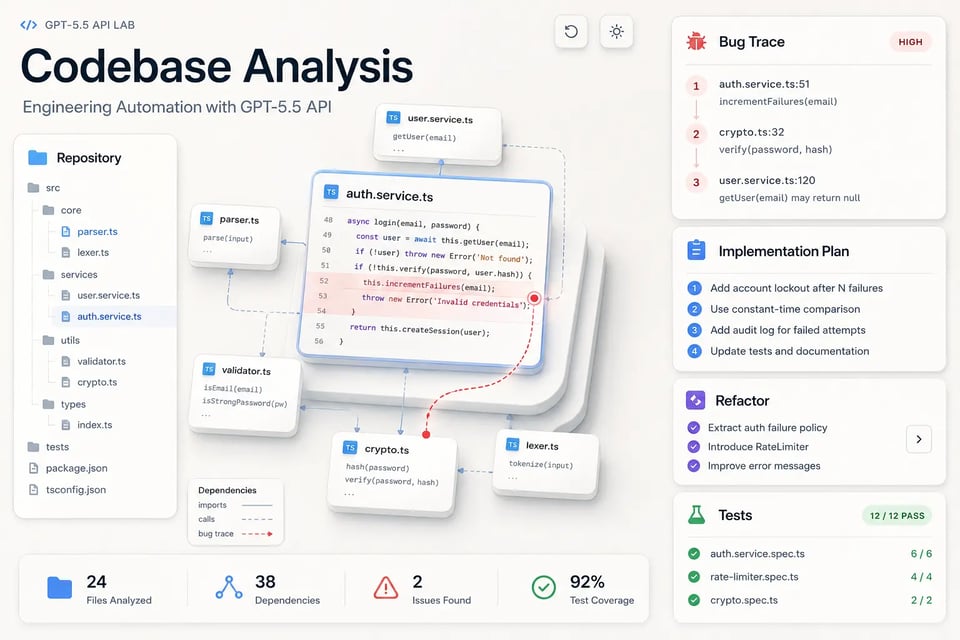
Codebase Analysis and Engineering Automation with GPT-5.5 API
GPT-5.5 API is well suited for engineering workflows that involve repository understanding, bug analysis, implementation planning, refactoring support, and test generation. Instead of treating every request as a standalone code snippet, GPT-5.5 API can help reason across related files, trace technical dependencies, explain failure causes, and maintain a clearer view of the full software task.
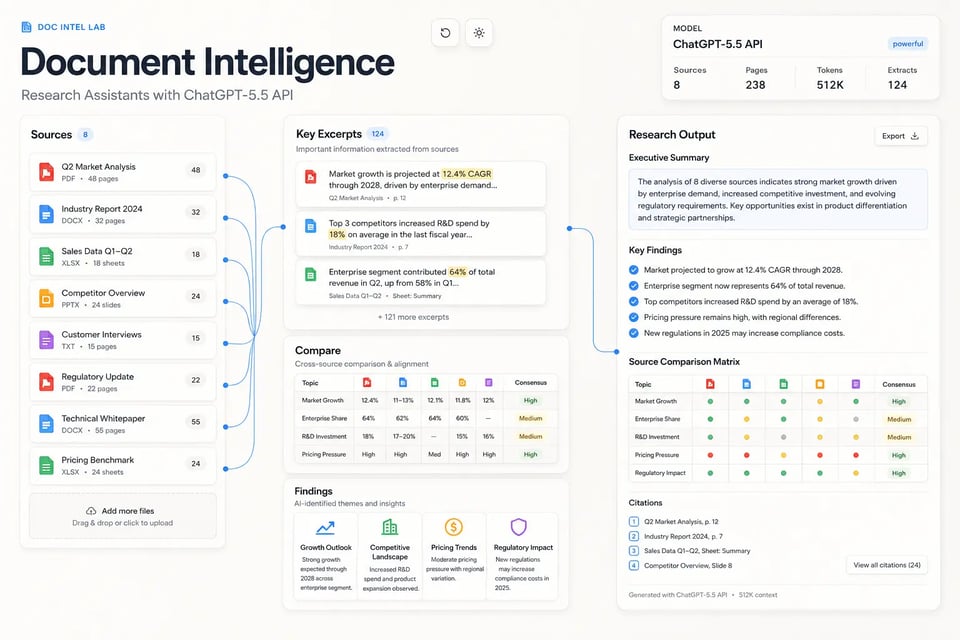
Document Intelligence and Research Assistants with ChatGPT-5.5 API
ChatGPT-5.5 API can power products that need to process long documents, compare multiple sources, extract important information, and produce structured research outputs. This fits workflows such as report summarization, policy review, technical documentation analysis, contract understanding, academic research support, and knowledge-base reasoning where context depth and output clarity are important.
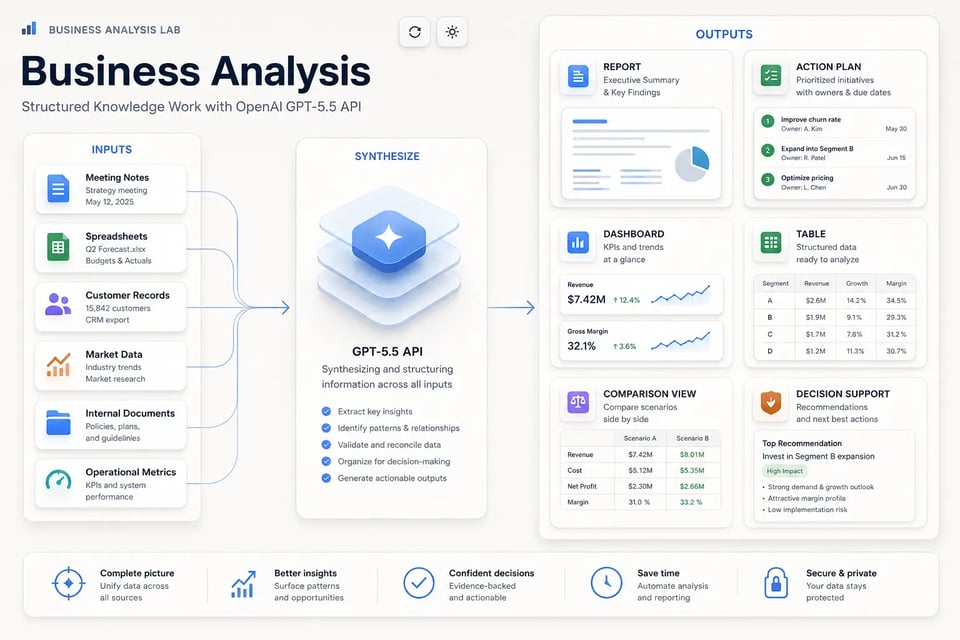
Business Analysis and Structured Knowledge Work with OpenAI GPT-5.5 API
OpenAI GPT-5.5 API can support business workflows that turn scattered inputs into organized deliverables. Meeting notes, spreadsheets, customer records, market information, internal documents, and operational data can be transformed into summaries, reports, action plans, tables, and decision-support content that are easier for teams to review and use.
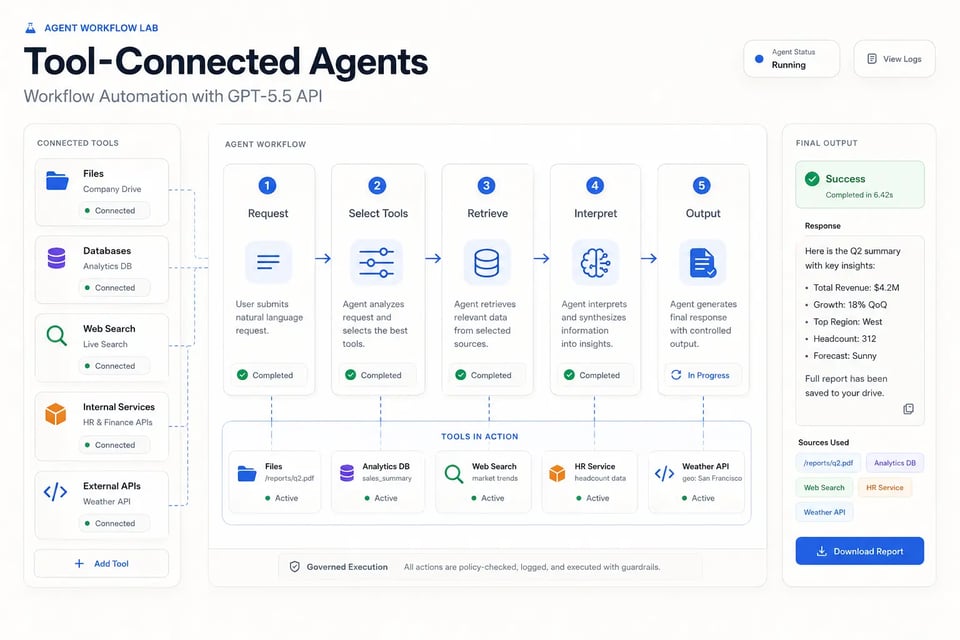
Tool-Connected Agents and Workflow Automation with GPT-5.5 API
GPT-5.5 API can serve as the reasoning layer for agents that interact with tools, files, databases, search systems, or internal services. The value comes from coordinating multiple steps: understanding the user request, selecting relevant information, interpreting returned results, and producing a controlled output that fits the workflow instead of stopping at a single text response.